




Cycle of Remembering
Acrylic on canvas, 70 × 70 cm
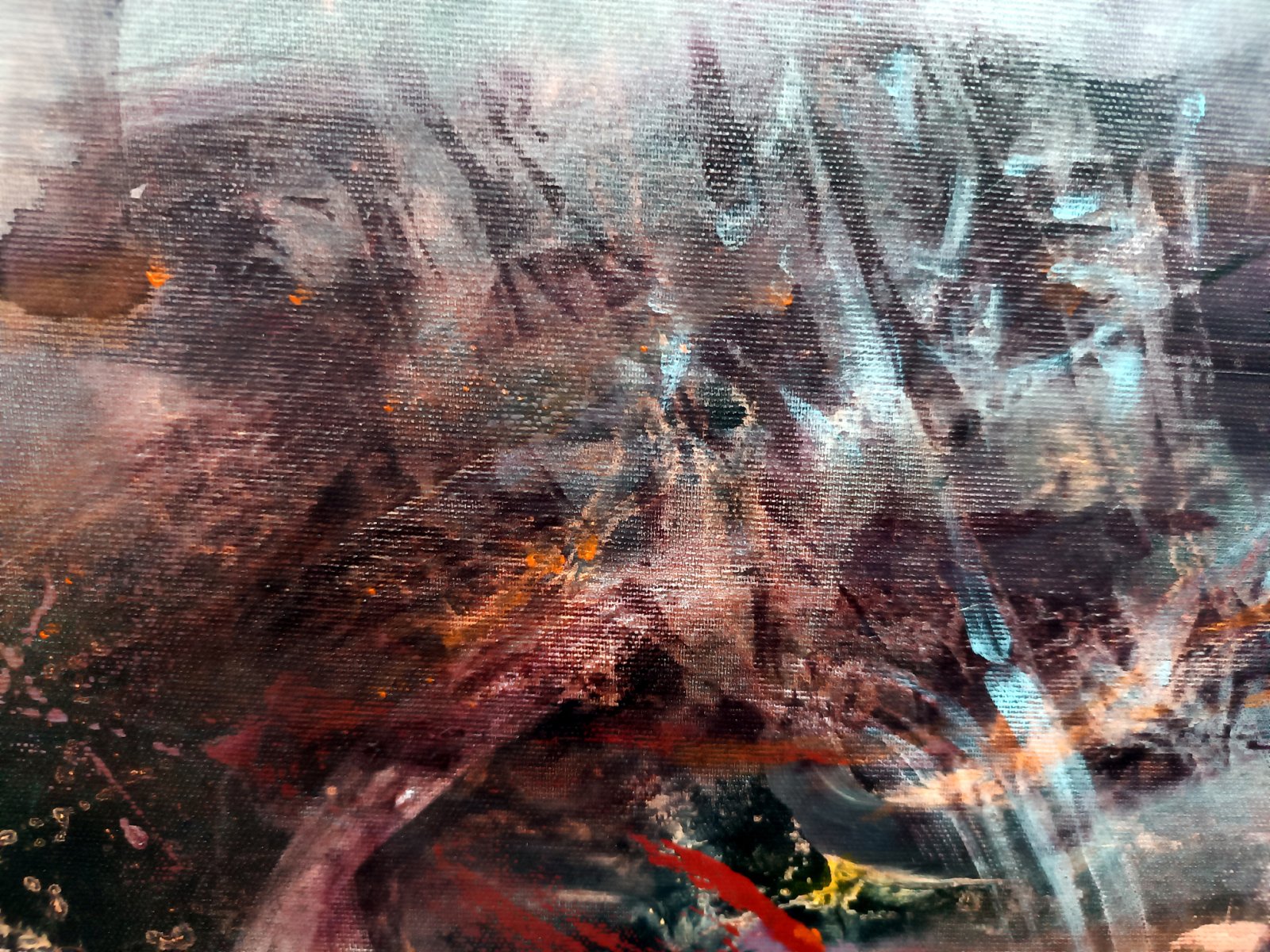
This new painting extends the Cycle of Remembering not as a continuation of imagery, but as a deepening of its psychological and material logic. Where the earlier diaphanous compositions operated through translucency, suspension, and a sense of memory held at a distance, this work feels like the moment when remembrance condenses—when what was once vaporous acquires weight, resistance, even friction.
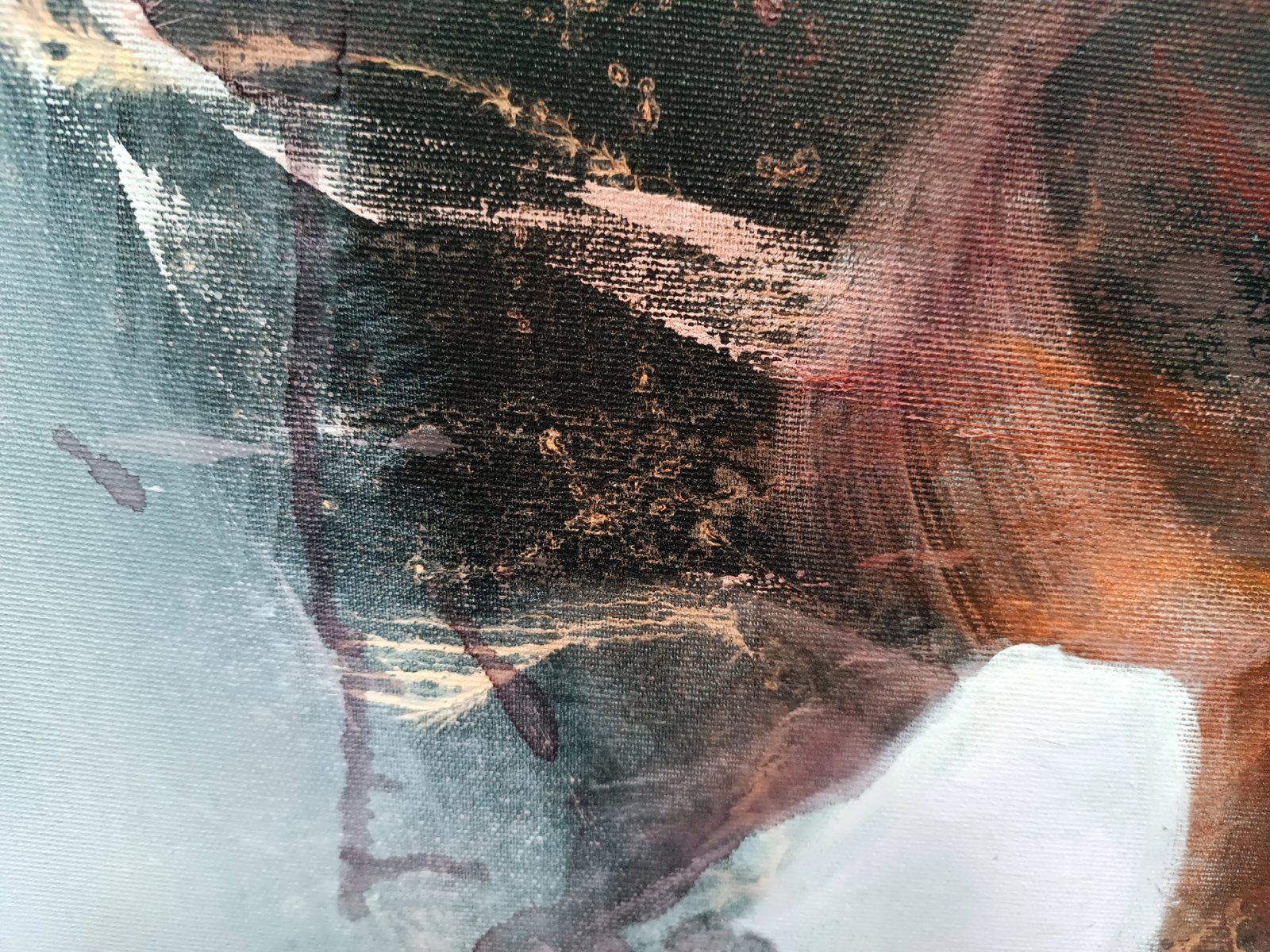
The composition is anchored by a dense central mass that oscillates between figuration and abstraction. It suggests a body without declaring one, a presence that refuses legibility. This ambiguity is crucial: memory here is not illustrative but somatic. The painting does not depict remembering; it enacts it. Layers of pigment are dragged, scraped, and partially erased, producing a surface that behaves like a palimpsest—each gesture simultaneously revealing and obscuring what came before. This recalls the earlier cycle’s concern with transparency, but reverses its direction: instead of looking through memory, we are now confronted by its sediment.
The pale, almost void-like passages puncturing the darker field function as moments of rupture. In the Cycle of Remembering, light zones often suggested permeability, a gentle passage between states. Here, they feel more surgical—absences cut into the mass, breathing holes or wounds. They introduce vulnerability into the structure, preventing the work from becoming monolithic. These openings imply that remembering is never whole; it is interrupted, incomplete, shaped as much by what is missing as by what remains.
Color plays a decisive emotional role. The earthy reds, bruised browns, and muted greens carry a corporeal resonance, while the cool greys maintain a distancing, almost mnemonic haze. This chromatic tension mirrors the conceptual one: the struggle between intimacy and detachment, between embodied memory and its gradual abstraction over time. Compared to the earlier, more atmospheric works, this palette feels grounded, even burdened—as if memory has crossed a threshold from contemplation into confrontation.
Spatially, the painting resists stable orientation. There is no clear horizon, no secure ground. This instability aligns with the cyclical nature of remembering you’ve been developing: memory does not progress linearly but loops, returns, collapses inward. The viewer is drawn repeatedly back to the center, yet never fully granted access. In this sense, the work refuses closure. It insists that remembering is not resolution but persistence.
Ultimately, this painting marks a critical evolution within the cycle. If the earlier diaphanous works asked how memory lingers, this one asks what memory does to the body—to form, to matter, to paint itself. It is heavier, more conflicted, and more exposed. Rather than dissolving into atmosphere, memory here presses forward, insisting on being felt.
